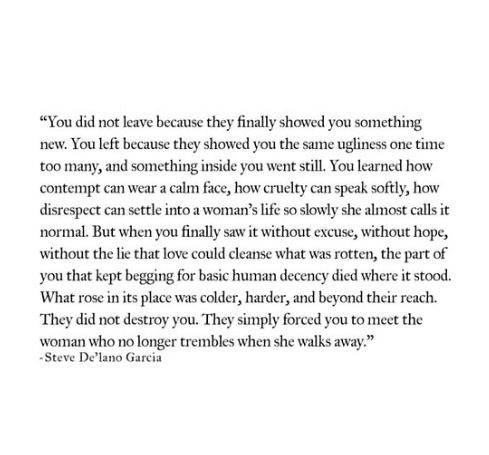
"Some endings crawl into a woman’s life like poison in clean water, and by the time she tastes it, the damage is already inside her. She does not arrive at that ending quickly. She is dragged there by repetition.
By the slow accumulation of slights, contempt, coldness, and calculated carelessness dressed up as ordinary human flaws. She spends too long trying to be fair. Too long trying to be mature. Too long trying to see the wound in those who keep wounding her, as if understanding the source of their ugliness could somehow make its effect on her body, mind, and spirit less severe. It does not. It only teaches her how much pain a woman can normalise before she finally recoils from it.
There is a particular kind of exhaustion that comes from being treated badly by someone who knows exactly what they are doing and counts on your decency to keep the arrangement alive. It strips a woman down quietly. Not in one grand catastrophe, but in a sequence of moments so insulting, so repetitive, that eventually her inner world starts to feel like a room with the air taken out of it. She keeps showing grace, keeps offering patience, keeps extending humanity, not because she is naïve, but because she would rather hold her dignity than descend into the filth of their conduct. Yet dignity has a cost when it is continually spent on people who feel entitled to consume it.
The last straw is rarely grand enough to satisfy an audience, which is part of what makes it so vicious. It can be a glance heavy with contempt. A sentence tossed at her as if she were too worn down to hear the insult buried inside it. A casual act of disregard committed by someone who has grown so comfortable with harming her that they no longer even bother to disguise it. To anyone standing outside, it may look minor. Almost forgettable. But the body knows. The spirit knows. The part of her that has been forced to carry years of swallowed anger, humiliation, and disappointment knows exactly what has just happened. And that is when the final turn begins.
Recognition is colder than rage and far more decisive. Rage still argues. Rage still wants to be seen, answered, met. Recognition does not beg. It does not perform. It does not ask for clarification from those who have built their comfort on confusion. It simply opens its eyes and sees the full pattern at once. Suddenly every insult stands up in a clear line. Every excuse she accepted turns stale in her mouth. Every apology reveals itself as theatre. Every repeated offence exposes the truth that was there all along: they were not failing to understand her; they were refusing to care.
A woman reaches a dreadful kind of peace when she no longer needs the person who harmed her to admit what they did. That peace is not gentle. It is severe. It arrives like a locked gate. She stops spending language on people committed to distortion. She stops arranging her pain into neat little explanations for those who benefit from misunderstanding her. She stops handing over evidence, stops revisiting scenes of humiliation, stops standing in the court of someone else’s shallow judgment, asking to be recognised as worthy of basic respect. The trial is over. The verdict has already been delivered in her bones.
There is something almost unnerving about the moment a woman goes still after being pushed too far. Many people mistake that stillness for numbness because they do not understand what they are seeing. But numbness is not the right word. It is the burial of false hope. It is the death of the version of her that kept volunteering for pain under the banner of love, loyalty, patience, or faith. It is the part of her that once said, perhaps if I explain it better, perhaps if I hurt more quietly, perhaps if I remain good enough, small enough, useful enough, they will stop. When that part dies, it does not die with noise. It dies in silence, and that silence changes everything.
She begins, then, to look at the history of it without sedation. The memories no longer come softened by longing. They come sharp. Uncovered. She sees how many times she lowered her standards to accommodate conduct that should have revolted her. She sees how often she was expected to absorb what would have shattered less disciplined people. She sees the ways she was trained to doubt her own perception whenever she reacted like a human being to being treated cheaply. Most sickening of all, she sees how often she mistook survival for devotion. She was not building something sacred. She was enduring what should have ended much sooner.
One of the hardest truths a woman can swallow is that some people never misread her kindness; they correctly read it as access. They saw her patience and understood that it gave them more time. They saw her empathy and understood that it gave them cover. They saw her efforts to keep the peace and understood that it made her easier to corner, easier to silence, easier to keep in a cycle where she was always the one doing the moral labour while they remained comfortably unchanged. Once she understands this, something in her hardens with purpose. Not into malice. Into the boundary. Into refusal. Into a standard that no longer asks whether someone meant well while they were diminishing her.
From there, a colder form of self-respect starts to take shape, and it does not care whether it is called harsh. She no longer measures her worth by how much she can endure without collapsing. She no longer mistakes tolerance for strength. She no longer glorifies suffering simply because she survived it. Survival is not always noble; sometimes it is simply what happens while she has not yet remembered she was allowed to leave. Once that memory returns, her whole posture changes. The woman who once stood there trying to negotiate with disrespect is gone. In her place stands someone who has finally understood that access to her is not a right, and continued access after contempt is a privilege no one should expect to keep.
People often fear this version of a woman because she no longer bleeds in ways that can be used against her. She does not offer dramatic scenes that they can point to later as proof of her instability. She does not throw herself into one final speech to make them see what they refused to see while benefiting from it. She does not hand them the intimacy of her devastation so they can feel important in the wreckage. Instead, she becomes quiet in a deeply unsettling way. Quiet with a decision. Quiet with completion. Quiet with the absolute understanding that she owes no final performance to the people who profited from her pain.
And once that shift has happened, the image she held of them begins to rot in front of her. Not because she suddenly becomes cruel, but because illusion cannot survive prolonged exposure to truth. The person she fought for starts to appear smaller, pettier, more transparent in their hunger for control, comfort, attention, or power. What once looked complex now looks cowardly. What once felt overwhelming now looks repetitive. What once kept her up at night begins to resemble exactly what it always was: someone who had countless opportunities to act with decency and chose otherwise because they believed she would remain available no matter what it cost her.
Walking away from that knowledge is not an act of ease; it is an act of self-preservation carried out at the edge of emotional frostbite. It hurts because she cared. It hurts because she invested time, trust, language, softness, and pieces of herself that will never come back in the same form. It hurts because there is grief in accepting that what she kept trying to protect was never protecting her. But the pain of leaving is cleaner than the sickness of staying. At least leaving does not require her to assist in her own diminishment. At least leaving does not ask her to participate in the slow erasure of her own spirit for the comfort of someone who has already shown her exactly how little she means to them when it counts.
So yes, she changes, and the change is not decorative. It is grave. It settles into her voice, her silences, her eyes, the way she now measures people without announcing what she sees. If she appears colder, it is because the warmth given blindly nearly cost her too much. If she appears harder, it is because being endlessly accommodating nearly hollowed her out. If she appears less reachable, it is because she has finally learned that not everyone who asks for closeness deserves proximity. The softness may still exist, but it is no longer lying in the open for anyone with dirty hands to touch.
What remains in the end is not the cheap triumph of pretending she was untouched. She was touched. Marked. Altered. There is no glory in denying that. But there is power in what she does next with that knowledge. She stops chasing the explanation. She stops kneeling before indifference. She stops shrinking to fit inside relationships that feed on the reduction of her full self. She stops confusing being chosen with being cherished. And when the final truth rises in her, it does not tremble.
She did not fail because someone could not meet her with honesty, care, or respect. She did not become less because another person treated her as if she were expendable. She did not lose anything worth keeping when she withdrew from what was draining her dry. What actually happened is colder, cleaner, and far more final than that.
She saw the truth.
And once she saw it, she chose herself."
-Steve De'lano Garcia
There is a particular kind of exhaustion that comes from being treated badly by someone who knows exactly what they are doing and counts on your decency to keep the arrangement alive. It strips a woman down quietly. Not in one grand catastrophe, but in a sequence of moments so insulting, so repetitive, that eventually her inner world starts to feel like a room with the air taken out of it. She keeps showing grace, keeps offering patience, keeps extending humanity, not because she is naïve, but because she would rather hold her dignity than descend into the filth of their conduct. Yet dignity has a cost when it is continually spent on people who feel entitled to consume it.
The last straw is rarely grand enough to satisfy an audience, which is part of what makes it so vicious. It can be a glance heavy with contempt. A sentence tossed at her as if she were too worn down to hear the insult buried inside it. A casual act of disregard committed by someone who has grown so comfortable with harming her that they no longer even bother to disguise it. To anyone standing outside, it may look minor. Almost forgettable. But the body knows. The spirit knows. The part of her that has been forced to carry years of swallowed anger, humiliation, and disappointment knows exactly what has just happened. And that is when the final turn begins.
Recognition is colder than rage and far more decisive. Rage still argues. Rage still wants to be seen, answered, met. Recognition does not beg. It does not perform. It does not ask for clarification from those who have built their comfort on confusion. It simply opens its eyes and sees the full pattern at once. Suddenly every insult stands up in a clear line. Every excuse she accepted turns stale in her mouth. Every apology reveals itself as theatre. Every repeated offence exposes the truth that was there all along: they were not failing to understand her; they were refusing to care.
A woman reaches a dreadful kind of peace when she no longer needs the person who harmed her to admit what they did. That peace is not gentle. It is severe. It arrives like a locked gate. She stops spending language on people committed to distortion. She stops arranging her pain into neat little explanations for those who benefit from misunderstanding her. She stops handing over evidence, stops revisiting scenes of humiliation, stops standing in the court of someone else’s shallow judgment, asking to be recognised as worthy of basic respect. The trial is over. The verdict has already been delivered in her bones.
There is something almost unnerving about the moment a woman goes still after being pushed too far. Many people mistake that stillness for numbness because they do not understand what they are seeing. But numbness is not the right word. It is the burial of false hope. It is the death of the version of her that kept volunteering for pain under the banner of love, loyalty, patience, or faith. It is the part of her that once said, perhaps if I explain it better, perhaps if I hurt more quietly, perhaps if I remain good enough, small enough, useful enough, they will stop. When that part dies, it does not die with noise. It dies in silence, and that silence changes everything.
She begins, then, to look at the history of it without sedation. The memories no longer come softened by longing. They come sharp. Uncovered. She sees how many times she lowered her standards to accommodate conduct that should have revolted her. She sees how often she was expected to absorb what would have shattered less disciplined people. She sees the ways she was trained to doubt her own perception whenever she reacted like a human being to being treated cheaply. Most sickening of all, she sees how often she mistook survival for devotion. She was not building something sacred. She was enduring what should have ended much sooner.
One of the hardest truths a woman can swallow is that some people never misread her kindness; they correctly read it as access. They saw her patience and understood that it gave them more time. They saw her empathy and understood that it gave them cover. They saw her efforts to keep the peace and understood that it made her easier to corner, easier to silence, easier to keep in a cycle where she was always the one doing the moral labour while they remained comfortably unchanged. Once she understands this, something in her hardens with purpose. Not into malice. Into the boundary. Into refusal. Into a standard that no longer asks whether someone meant well while they were diminishing her.
From there, a colder form of self-respect starts to take shape, and it does not care whether it is called harsh. She no longer measures her worth by how much she can endure without collapsing. She no longer mistakes tolerance for strength. She no longer glorifies suffering simply because she survived it. Survival is not always noble; sometimes it is simply what happens while she has not yet remembered she was allowed to leave. Once that memory returns, her whole posture changes. The woman who once stood there trying to negotiate with disrespect is gone. In her place stands someone who has finally understood that access to her is not a right, and continued access after contempt is a privilege no one should expect to keep.
People often fear this version of a woman because she no longer bleeds in ways that can be used against her. She does not offer dramatic scenes that they can point to later as proof of her instability. She does not throw herself into one final speech to make them see what they refused to see while benefiting from it. She does not hand them the intimacy of her devastation so they can feel important in the wreckage. Instead, she becomes quiet in a deeply unsettling way. Quiet with a decision. Quiet with completion. Quiet with the absolute understanding that she owes no final performance to the people who profited from her pain.
And once that shift has happened, the image she held of them begins to rot in front of her. Not because she suddenly becomes cruel, but because illusion cannot survive prolonged exposure to truth. The person she fought for starts to appear smaller, pettier, more transparent in their hunger for control, comfort, attention, or power. What once looked complex now looks cowardly. What once felt overwhelming now looks repetitive. What once kept her up at night begins to resemble exactly what it always was: someone who had countless opportunities to act with decency and chose otherwise because they believed she would remain available no matter what it cost her.
Walking away from that knowledge is not an act of ease; it is an act of self-preservation carried out at the edge of emotional frostbite. It hurts because she cared. It hurts because she invested time, trust, language, softness, and pieces of herself that will never come back in the same form. It hurts because there is grief in accepting that what she kept trying to protect was never protecting her. But the pain of leaving is cleaner than the sickness of staying. At least leaving does not require her to assist in her own diminishment. At least leaving does not ask her to participate in the slow erasure of her own spirit for the comfort of someone who has already shown her exactly how little she means to them when it counts.
So yes, she changes, and the change is not decorative. It is grave. It settles into her voice, her silences, her eyes, the way she now measures people without announcing what she sees. If she appears colder, it is because the warmth given blindly nearly cost her too much. If she appears harder, it is because being endlessly accommodating nearly hollowed her out. If she appears less reachable, it is because she has finally learned that not everyone who asks for closeness deserves proximity. The softness may still exist, but it is no longer lying in the open for anyone with dirty hands to touch.
What remains in the end is not the cheap triumph of pretending she was untouched. She was touched. Marked. Altered. There is no glory in denying that. But there is power in what she does next with that knowledge. She stops chasing the explanation. She stops kneeling before indifference. She stops shrinking to fit inside relationships that feed on the reduction of her full self. She stops confusing being chosen with being cherished. And when the final truth rises in her, it does not tremble.
She did not fail because someone could not meet her with honesty, care, or respect. She did not become less because another person treated her as if she were expendable. She did not lose anything worth keeping when she withdrew from what was draining her dry. What actually happened is colder, cleaner, and far more final than that.
She saw the truth.
And once she saw it, she chose herself."
-Steve De'lano Garcia