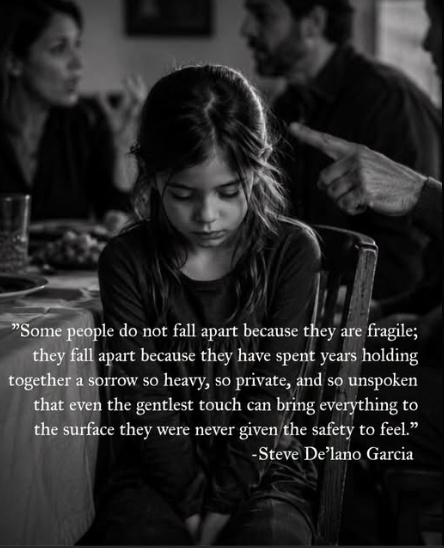
"Some human beings enter life already unwelcome in ways nobody should ever have to endure. Before they are old enough to understand language, they understand tension. Before they know what love is meant to feel like, they know the chill of being treated as a burden, an inconvenience, or a problem to be managed. They grow in the shadow of withheld affection, uncertain protection, and the kind of silence that presses down on a child until it begins to shape their entire inner world.
Later, people will call them distant, difficult, overly sensitive, guarded. Very few will stop to ask what had to happen for a person to learn, so early, that softness could not be relied upon. There is a grief that begins so young it settles into the bones and starts to feel ordinary. It is the grief of needing comfort and learning not to ask for it. It is the grief of reaching out and finding nothing steady there. It is the grief of slowly realising that the people who should have made the world feel safer were themselves the source of dread, confusion, or neglect.
That kind of pain does not remain neatly in childhood. It follows a person into every later attachment. It stands quietly behind every tender moment, whispering that closeness can vanish without warning, that warmth can be withdrawn, that safety can turn to humiliation in a single breath. After enough of that, trust is no longer simple. It becomes a risk the body resists even when the mind longs to surrender.
Many carry fear so constantly that others mistake it for personality. They call it shyness, overthinking, politeness, emotional intensity. They do not see that this person has been trained by experience to watch everything. A face changing expression. A sentence spoken too flatly. A pause in a reply. A shift in someone’s posture. These details are not small to them. They are signals that once mattered deeply.
Their body learned long ago that danger rarely announces itself with fairness. Sometimes it arrived in ordinary moments, during ordinary evenings, in voices that were calm enough to make the hurt even worse. So now they monitor everything. They brace before they need to. They apologise too quickly. They explain themselves before anyone has accused them. They live as if peace might suddenly prove false.
Some people are carrying wounds they cannot fully describe because the damage was repeated until it became part of the atmosphere of their life. They may not have one single memory they can point to and say, there, that was the moment everything changed. Instead, there were countless smaller injuries. Being dismissed when frightened. Being left alone with feelings too large for a child to hold.
Being spoken to without gentleness. Being made to feel ashamed of tears, need, fear, confusion, or pain. Over time, these moments gather inside a person until they begin to form a private law: do not need too much, do not speak too honestly, do not expect to be handled with care, do not believe that anyone will stay once you become difficult to carry.
The saddest part is how often this suffering learns to disguise itself as competence. The person becomes reliable, capable, self-contained, almost unnaturally calm. They are the one who says it is fine, who does not ask for much, who keeps going when others would have sat down and wept. They learn to carry distress silently because silence once felt safer than truth.
They become so skilled at managing themselves that the world mistakes this adaptation for strength. Praise arrives for how undemanding they are, how mature they seem, how little trouble they cause. Nobody notices that this so-called strength may have been built from repeated disappointment, from fear of rejection, from long practice at swallowing pain before it inconveniences anyone else.
There is nothing beautiful about what prolonged suffering can do to a person from the inside. It can leave them exhausted in ways rest does not touch. It can make affection feel dangerous. It can fill ordinary tenderness with panic because tenderness awakens need, and need has too often led to shame. Some become quiet to the point of near-disappearance. Some become watchful.
Some become desperate for reassurance and then humiliated by their own desperation. Some alternate between longing for closeness and shrinking from it the second it is offered. People often judge these contradictions harshly, not understanding that a frightened nervous system is trying to protect a life it has learned can be wounded at any moment.
What remains longest is often not the loudest cruelty but the intimate, repeated diminishment that taught a person who they were allowed to be. A tired sentence can live in the body for decades. A look of contempt can become an internal voice. A careless remark can harden into identity. You can grow up, leave, change cities, change names, build a career, find kinder people, and still hear the old message rising in quiet hours: you are too much, too sensitive, too needy, too difficult, too hard to love for long.
These messages do not fade simply because time has passed. They return in moments of closeness. They return after misunderstandings. They return when a text goes unanswered, when a face seems distant, when affection feels uncertain. They do not ask whether the present is safe; they assume it is not. And yet the people marked most deeply by sorrow are often the ones who notice pain in others with almost unbearable precision.
They hear the crack in a voice no one else registers. They can tell when someone says they are fine and means the opposite. They recognise forced cheerfulness, strained breathing, the smile that arrives a second too late. This sensitivity is not sentimental. It was learned through necessity. They became fluent in small signs because once their own survival may have depended on reading them correctly.
So when they care, they care with an attentiveness that can bring tears to the surface. They remember what unsettles you. They remember the date you dread. They remember the tone you used when you tried to hide your distress and failed. They notice because they know what it is to need noticing and not receive it.
Sometimes kindness undoes a wounded person more than cruelty ever could. Cruelty confirms what they have long feared. Kindness unsettles the structure built around that fear. A gentle question. A patient silence. A voice that does not harden when they falter. A hand that does not withdraw the moment their pain becomes inconvenient. These things can reach places inside them that have gone untouched for years.
And when those places are reached, grief can rise with frightening force. Not only grief for the present hurt, but grief for all the tenderness that should have been there earlier and was not. Grief for the child who learned to self-soothe with no real comfort. Grief for the younger self who mistook endurance for worth. Grief for how long they went without being handled with care.
One of the most desolate experiences in human life is to be surrounded and remain unseen where it matters most. A person can be known socially, professionally, domestically, even affectionately, and still feel that the deepest truth of them has not been reached. Others may know their routines, preferences, humour, habits, and history, while remaining strangers to the quiet panic they carry, the shame that follows them, the effort it takes to appear ordinary.
This kind of loneliness does not come from physical solitude. It comes from the repeated discovery that people can love your surface while never touching the place in you that is most frightened, most tender, most in need of understanding. After enough of that, many stop trying to be known in full. They begin to ration disclosure. They offer the edited self. They spare others the heavier truths.
Beneath the appearance of independence there is often someone tired beyond language. They may seem composed because they have learned how to function while distressed. They may seem detached because feeling everything fully at once would overwhelm them. They may seem strong because collapse had no safe place to happen. But inside there may still be a younger self who never stopped waiting for steadiness, who still braces before asking for anything, who still feels a stab of shame at the simple desire to be comforted.
This is one of the quieter tragedies of long suffering: it can make ordinary human needs feel humiliating. To want reassurance can feel weak. To want gentleness can feel childish. To want someone to stay can feel like asking for too much. So they deny these needs in speech while aching from them in private. Love does not always soothe such people in the simple way others imagine.
Very often it exposes just how frightened they are. To care deeply is to become vulnerable to repetition. To let someone matter is to risk the old injuries being touched again. Even joy can carry sorrow inside it, because closeness sharpens awareness of how much can be taken away. A person may lie beside someone they cherish and still feel tears gathering for reasons they cannot fully explain. The warmth is real, the affection is real, and still fear rises.
Not because they are ungrateful. Not because the love is false. Because part of them has learned that precious things can disappear, and the body does not easily forget what it once survived. Still, some continue in spite of everything that should have closed them entirely. Not with cheerfulness, not with clean healing, not with easy faith in people, but with a quieter and more painful persistence. They get up carrying old sorrow and still answer the day.
They move through work, errands, obligations, and conversations while privately bearing more than others know. They offer care they were rarely given. They keep some small opening in themselves, though experience has given them every reason to shut it. This does not make them flawless. It does not erase bitterness, fear, or exhaustion. It simply means that something in them has not fully given up on the possibility of being met with patience, truth, and steadiness.
I do not think the most moving form of courage is loud or triumphant. I think it is found in those who have been hurt so deeply they no longer expect rescue, yet continue to live with as much tenderness as they can manage. It is found in those who speak gently though life did not speak gently to them. It is found in those who are still capable of care after being given so little of it. It is found in the person who cries in private, washes their face, and carries on because there is no alternative. It is found in the person who is frightened of love and still reaches, however shakily, for connection.
There is something almost unbearable in that effort. Not polished courage. Not noble suffering. Simply a human being, marked heavily by pain, still trying not to become entirely unreachable. Perhaps that is what stays with me most. Not recovery in its tidy form, not the comforting fiction that every hurt can be cleanly resolved, but the sight of a person who has been shaped by grief and still retains the ability to feel deeply.
They may never become carefree. They may never stop carrying certain fears. They may never fully silence the old voices that taught them to doubt their worth. But if they can still respond to another person’s distress with gentleness, if they can still long for closeness despite all that has taught them to fear it, if they can still hope in small, cautious, trembling ways, then something profoundly human remains alive in them. And sometimes that fragile persistence is the most moving thing one person can witness in another."
-Steve De'lano Garcia




Comments
No comments yet. Be the first to share your thoughts!
Leave a comment