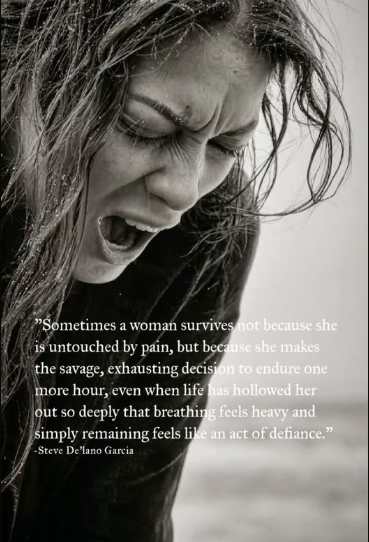
"Sometimes life does not merely wound a woman; it crushes the breath out of her, leaves her on her knees in private, and dares her to find a reason to rise again.
One day she is moving through ordinary life, carrying her responsibilities, answering to everyone who needs something from her, and the next she is confronted with a pain so deep it alters the air around her. It is not dramatic in the way stories often make pain seem. It is quieter than that, and far more severe. It sits in her chest. It follows her into the morning. It stares back at her from the mirror when her face is tired and there is no energy left to hide the truth. This is where life becomes painfully honest. Not in grand speeches or neat lessons, but in the silent recognition that some wounds cut so deeply they divide a life into before and after.
A woman can be carrying an agony nobody around her truly sees. She can still go to work, still wash the dishes, still reply to messages, still smile politely when spoken to, all while something inside her feels as though it is collapsing under a weight too heavy to name. This is one of the cruellest parts of deep suffering: the world often keeps asking for normality from those who are barely managing to stay upright. People see movement and assume strength. They see composure and assume healing. They hear quietness and assume peace. But so often, composure is simply desperation trained to sit still. So often, silence is not calm but exhaustion. A woman may be surviving minute by minute while everyone around her believes she is coping well. There is a private sorrow in that, in being expected to continue functioning while inwardly feeling as though you are carrying grief in your own flesh.
The truth no one wants to hear is that certain kinds of pain cannot be avoided, softened, or reasoned away. A woman cannot simply tell herself to stop hurting because enough time has passed or because others have grown uncomfortable with the sight of her suffering. She must go through it. She must feel the full weight of what happened, even when it seems almost unbearable. She must sit with the grief, the anger, the fear, the emptiness, the confusion, and the exhaustion. She must face the fact that some things change a person permanently. There is no shame in that. It is not a weakness to be altered by what nearly took you under. It is simply the truth. Some experiences do not leave a woman untouched. They strip away illusions. They expose how fragile life can be. They teach her, in the hardest possible way, that healing is not about becoming who she was before, but learning how to live faithfully within what she has now become.
There will be days when progress looks insultingly small. All she may do is rise from bed, wash her face, eat something without appetite, answer one message, or make it through another evening without completely giving way to despair. But this is how survival often looks when life has cut deeply enough. Not glorious. Not inspiring. Not tidy. Just small, stubborn acts repeated in the middle of deep pain. Piece by piece, she gathers herself. Piece by piece, she builds something that does not yet feel strong, but is still standing. She may not recognise her own endurance because it is taking place in such ordinary ways, yet those ordinary ways are where the real work is being done. Every hour she survives honestly matters. Every moment she refuses to surrender to the lie that this pain will destroy her matters. Even when she feels emptied, there is still something within her choosing to remain.
Some suffering does not leave cleanly. It lingers in the body, in memory, in the instinct to brace for danger even when the day is calm. A certain date can unsettle her before she even understands why. A particular place can make her feel watched by the past. Silence can become too loud. A peaceful moment can feel suspicious because she has learned how quickly peace can be taken away. This does not mean she is failing. It means she has been marked by what she has survived. A woman who has suffered deeply may carry that knowledge for a long time. She may hesitate before trusting joy. She may hold back from tenderness because she knows how much it can cost when life strikes where love once lived. These are not flaws of character. There are consequences. They are what happens when pain has been serious enough to leave its imprint on the soul.
And yet, somewhere inside this long, difficult passage, a deeper strength begins to form. Not the polished sort people admire from a distance, but something sterner, quieter, and far more real. It is the strength of a woman who has wept in private and still fulfilled what the day demanded. It is the strength of someone who has begged God for relief and still kept going when relief did not come quickly. It is the strength of carrying sorrow without allowing it to erase every last part of the self. She may not feel strong. She may feel frightened, tired, and profoundly changed. But there is an undeniable force in a woman who has been brought low and continues anyway. Not because she is untouched by pain, but because she has learned how to stand in its presence without letting it claim the whole of her.
So when life becomes severe, when the weight of it feels almost impossible to bear, she must remember that she does not have to conquer it in one perfect act. She does not have to be graceful. She does not have to have uplifting words. She does not have to heal on anybody else’s timetable. She only has to keep going as she is able. One breath. One hour. One difficult day at a time. She can cry and continue. She can be afraid and continue. She can feel emptied out and still continue. And in that quiet, relentless persistence, she will slowly discover that even the hardest pain does not always get the final word. It may mark her. It may alter her. It may leave traces that never fully fade. But it will not erase her. She remains. And sometimes that is the most powerful truth a woman can carry through the fire."
-Steve De'lano Garcia


Comments
No comments yet. Be the first to share your thoughts!
Leave a comment