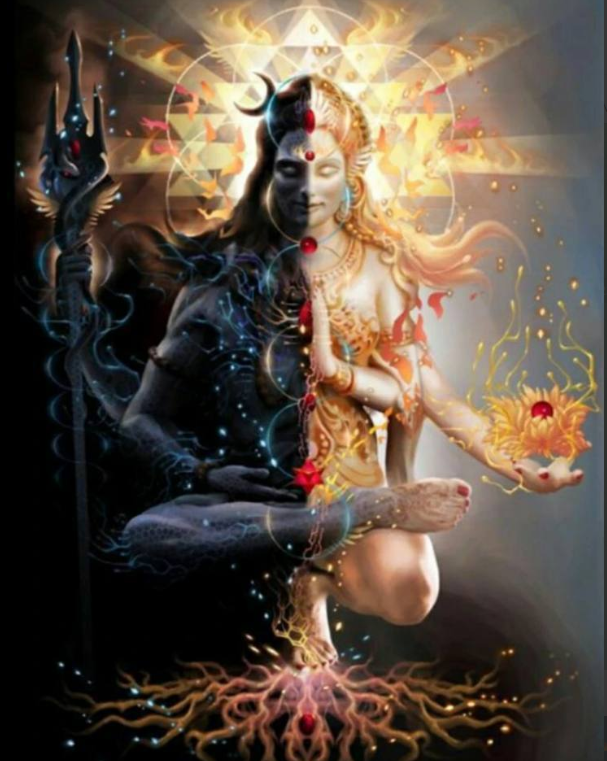
Owing to the fact that in a way, Shakti is more accessible to the human understanding (because this regards aspects of life that are closely related to the human condition inside the creation), the cult of the Goddess (DEVI) has spread more forcibly.
This cult was combined with notions of the Shamkhya philosophy and has offered the premises necessary to the later Maya doctrine, formulated by the sage Shankaracharya.
This possibility of combining, of interpenetration of two or more notions belonging to two or more spiritual systems is due to the fact that the Hindu philosophical systems are not isolated, closed systems, but complex and manageable doctrines, which may adjust and may be understood from different perspectives.
The Samkhya philosophy promulgates a primordial cosmic duality. From the Tantric perspective, this “scheme” of creation is transformed, in the sense that the two cosmic principles are considered united, not separated. This is the fundamental difference introduced by Tantra, based on a conception that favours the unity between the two principles, opposed in appearance, but indissoluble united in each act of the creation.
Nevertheless, Tantricism confers to Shiva and Shakti the qualities of the feminine and masculine principles from the Samkhya philosophy.
The idea of an act of fertilisation at the divine, purely spiritual level comes to life and is admitted in the tantric cosmogonic conception, unlike the Samkhya philosophy. The eternal and indestructible union between Shiva and Shakti gives birth to the whole macrocosm, in its stable, static aspect as well as in its dynamic one.
The different representations in the rich tantric iconography obviously underline the antithetic characteristics of the two principles, determining a more clear understanding.
Thus, on one hand is presented the cosmic dance of Shakti on the lying body of Shiva. On the other hand, the two deities are pictured in what is called VIPARITA-MAITHUNA, meaning tantric sexual union. This sexual union is different from what is usually understood by this in the western traditions, in the sense that man is immobile, while the woman, embracing him, assumes an active role during the sexual act.
In conclusion, the Tantrism envisages the cosmic evolution as a polarisation within the Supreme Being, which is God, the Unmanifested Absolute, in its two fundamental aspects: static and kinetic.
Tantra symbolises this aspect by comparing the couple Shiva and Shakti with a seed of grain (CHANAKA). Such a seed is made up of two halves so closely linked that they seem one, and one single cover covers them. Symbolically, the two halves represent Shiva and Shakti, the cover represents Maya (the cosmic illusion). When the cover is on, the two halves are separated, but the cover goes off when the seed is about to germinate, unifying thus the two halves in one.
Shankara was an 8th century Hindu sage and scholar who founded Advaita Vedanta, a school of philosophy known as nontheistic non-dualism. He wrote more in a religious and accessible manner rather than through pure logic. He was an ascetic and spoke mostly to intellectuals and ascetics. I turn to him whenever I want to read more about Advaita Vedanta. In Advaita Vedanta, there are three primary elements to Brahman, the Supreme. They constitute the true nature of the Ultimate, of Brahman. They are Being, Consciousness and Bliss, what is called Saccidananda in Sanskrit. Sat is Sanskrit and means being, Cit means consciousness or spirit, and ananda refers to joy or bliss. Ultimate Reality is One, non-dual yet has three distinct natures. Ultimate Reality is Nirguna Brahman, without attributes, about which no thing can really be stated because it is beyond paradox. In Advaita Vedanta, the Atman (individual soul) is none other than Brahman. There is no dualism. Hindus would use the metaphor of the Ataman being the wave and Brahman is the ocean. There are similarities to the Mind of Clear Light referred to in Buddhism. In both, the mind does perceive the unity behind all illusion. In Buddhism, the description of the Mind of Clear Light is more conceived as emptiness whereas in Advaita Vedanta, Brahman is full of bliss. Also, in Buddhism, there is no soul, while in Advaita Vedanta, the soul reincarnates from lifetime to lifetime, but always retains its Ultimate true nature, Nirguna Brahman.
This possibility of combining, of interpenetration of two or more notions belonging to two or more spiritual systems is due to the fact that the Hindu philosophical systems are not isolated, closed systems, but complex and manageable doctrines, which may adjust and may be understood from different perspectives.
The Samkhya philosophy promulgates a primordial cosmic duality. From the Tantric perspective, this “scheme” of creation is transformed, in the sense that the two cosmic principles are considered united, not separated. This is the fundamental difference introduced by Tantra, based on a conception that favours the unity between the two principles, opposed in appearance, but indissoluble united in each act of the creation.
Nevertheless, Tantricism confers to Shiva and Shakti the qualities of the feminine and masculine principles from the Samkhya philosophy.
The idea of an act of fertilisation at the divine, purely spiritual level comes to life and is admitted in the tantric cosmogonic conception, unlike the Samkhya philosophy. The eternal and indestructible union between Shiva and Shakti gives birth to the whole macrocosm, in its stable, static aspect as well as in its dynamic one.
The different representations in the rich tantric iconography obviously underline the antithetic characteristics of the two principles, determining a more clear understanding.
Thus, on one hand is presented the cosmic dance of Shakti on the lying body of Shiva. On the other hand, the two deities are pictured in what is called VIPARITA-MAITHUNA, meaning tantric sexual union. This sexual union is different from what is usually understood by this in the western traditions, in the sense that man is immobile, while the woman, embracing him, assumes an active role during the sexual act.
In conclusion, the Tantrism envisages the cosmic evolution as a polarisation within the Supreme Being, which is God, the Unmanifested Absolute, in its two fundamental aspects: static and kinetic.
Tantra symbolises this aspect by comparing the couple Shiva and Shakti with a seed of grain (CHANAKA). Such a seed is made up of two halves so closely linked that they seem one, and one single cover covers them. Symbolically, the two halves represent Shiva and Shakti, the cover represents Maya (the cosmic illusion). When the cover is on, the two halves are separated, but the cover goes off when the seed is about to germinate, unifying thus the two halves in one.
Shankara was an 8th century Hindu sage and scholar who founded Advaita Vedanta, a school of philosophy known as nontheistic non-dualism. He wrote more in a religious and accessible manner rather than through pure logic. He was an ascetic and spoke mostly to intellectuals and ascetics. I turn to him whenever I want to read more about Advaita Vedanta. In Advaita Vedanta, there are three primary elements to Brahman, the Supreme. They constitute the true nature of the Ultimate, of Brahman. They are Being, Consciousness and Bliss, what is called Saccidananda in Sanskrit. Sat is Sanskrit and means being, Cit means consciousness or spirit, and ananda refers to joy or bliss. Ultimate Reality is One, non-dual yet has three distinct natures. Ultimate Reality is Nirguna Brahman, without attributes, about which no thing can really be stated because it is beyond paradox. In Advaita Vedanta, the Atman (individual soul) is none other than Brahman. There is no dualism. Hindus would use the metaphor of the Ataman being the wave and Brahman is the ocean. There are similarities to the Mind of Clear Light referred to in Buddhism. In both, the mind does perceive the unity behind all illusion. In Buddhism, the description of the Mind of Clear Light is more conceived as emptiness whereas in Advaita Vedanta, Brahman is full of bliss. Also, in Buddhism, there is no soul, while in Advaita Vedanta, the soul reincarnates from lifetime to lifetime, but always retains its Ultimate true nature, Nirguna Brahman.



Comments
No comments yet. Be the first to share your thoughts!
Leave a comment